A look at the History of Lighting and How to Re-Create the Styles Today

We'll talk you through the fashions and styles of the eras:
The Medieval period ran from 800 to 1500. Medieval lighting came from large central fireplaces, candles, rush lights, flaming torches or lanterns. Candles, which had been around since Roman times, were made from animal fat, or beeswax if you were wealthy. Rush lights were simply tapers of rush stalks dipped into melted fat whilst the torches would have been made from wood bound in rags and impregnated with fat and set into metal brackets. Medieval lanterns were simply candles in a metal frame. Primitive lamps were also a feature of later Medieval lighting and were either suspended from above on chains or sat on table tops. These oil lamps were simple in design for the poor, or more elaborate lights with heraldic decorations for the wealthy.
Lighting is key to recreating the mood and atmosphere of Medieval times. Consider simple rustic table lamps, torchiers or wall sconces aimed at the ceiling. Overhead lighting such as wrought iron cartwheel style chandeliers or rustic black wrought iron lanterns will add to the look. Consider installing a dimmer switch to control the light levels. These lights look particularly good in rooms with high ceilings or in barn conversions.
Bespoke Lights selection of ready-made Medieval lighting includes lots of forged wrought iron light fittings which have been designed to replicate the rustic metal fittings of the time. Working with our UK manufacturing partners we can offer a bespoke service to our customers to have their own light fitting manufactured in wrought iron.
The Gothic style was dominant in late Medieval times, from around 1180 to 1500. A Gothic revival period occurred in late 18th century when it became known as Gothick and later again as Victorian Gothic. One of the main features of Gothic architecture was the elegant pointed arches used in churches, monasteries, cathedrals and castles. Windows developed from the simple small openings to wider and richly decorated arched windows that gave a feeling of height. They would often be filled with coloured stained glass. Other Gothic features included decorative schemes depicting biblical stories, figures of saints and gargoyles. During the Victorian Gothic Revival period many of our older Universities and the Houses of Parliament were built in Gothic style.
Buildings from the Gothic period or in that style benefit from having lighting that is in keeping. One of the best materials for producing reproduction Gothic Lighting is wrought iron. Large black wrought iron chandeliers and circular cartwheel lights in dark ironwork would have been typical of the lighting of this period. These lights can be recreated using candle style light bulbs rather than real candles. Much of the metalwork on Gothic Lighting is decorated with the Gothic motifs that were popular at the time – leaves and scrolls were particularly common.
Bespoke Lights have a selection of wrought iron chandeliers in various sizes to suit both large and small spaces. The larger Gothic dark metal lights would have been hung in formal dining rooms or entrance hallways. Wall sconces in wrought cast iron and arched Gothic metal lanterns are also in keeping. The metal used in Gothic lights was mostly dark brown or black and wrought iron lends itself readily to being used to for this purpose. Although you may not initially think of Tiffany lights when you are looking for Gothic Lighting, it is well worth considering. Some of the Tiffany handmade glass replicates the stained glass windows of Gothic churches and cathedrals, and a carefully chosen Tiffany lamp would certainly not be out of place. Gothic lighting can work extremely well in barn conversions where a large long drop bespoke wrought iron chandelier would look stunning hanging by a double height window or in a galleried hallway.
Heraldic lighting was simply Medieval style lighting that was decorated with heraldic emblems. The nobility and royalty of the time would display their coat of arms on shields and banners used in battle and also on many objects within the Medieval castles and homes of the wealthy. The Medieval metal chandeliers and lanterns would have depicted their coat of arms and the stained glass windows of many ecclesiastical buildings would have included heraldic emblems. The Fleur de Lys design was popular, as was the tree of life and mythical beasts.
Bespoke Lights have a collection of wrought iron lighting that features heraldic emblems that would be ideal for that medieval baronial look. If you are lucky enough to have your own coat of arms, why not have a metal wrought iron light made especially for you, depicting your very own coat of arms? We can manufacture lighting in forged wrought iron and have a selection of skilled British craftsmen who will work with us to produce quality lighting especially for you. Just contact us to see what can be achieved.
The Tudor period was from 1485 to 1603 and during this time the upper and middle classes became wealthier and their homes more comfortable. The houses of the nobility, gentry and merchants had many large rooms with chimneys and fireplaces to keep them warm and to accommodate family, guests and servants. Homes were full of beautiful woodwork – elaborate carvings, oak panelled walls and intricately carved 4 poster beds. By stark contrast about 50% of the population lived in poverty, were largely illiterate and their homes were simple thatched huts with one or two rooms.
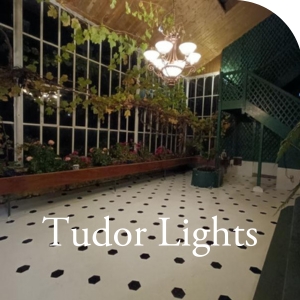
The wealthier homes would have had small leaded glass windows to let natural light in and artificial lighting would have been provided by beeswax candles. Tudor light fittings would have been heavy dark metal chandeliers often with Gothic motifs and heraldic shields. Metal wall sconces and lanterns were also popular. The poorer homes would have had simple wooden shutters which could only be opened during warmer weather so artificial light was needed during the daytime as well as at night for much of the year. Lighting was provided by rush lights made by dipping dried peeled rushes in animal fat, and by tallow candles also made from animal fat.
To recreate the feel of Tudor lighting today consider having fittings in dark metal or bronze. Forged wrought iron is ideal and in keeping with lights from the Tudor time. Circular cast iron chandeliers with candle style lights and decorated with Gothic motifs, scrolls or heraldic emblems would work well. Lanterns with leaded glass, dark metal wall sconces and torches, and metal candle style table lamps are all in keeping. Try to avoid having metalwork too shiny and steer clear of any dangling crystal or glass decorations.
Elizabeth 1 was the last of the Tudor monarchs and reigned from 1558 to 1603, a period that became known as the Golden Age. This was the period of the great explorers and England became a leading Naval and commercial power. There were new ideas in science and technology, and music, arts and theatre all flourished. However, as previously, life for the poor was still harsh with many now living in the large towns and cities in slum conditions. Black and white half-timbered houses with overhanging first floors made the streets dark. Brick and stone built houses with leaded casement windows were reserved for the wealthier homes.
Artificial lighting was still provided by candlelight and open fires. Dark metal chandeliers suspended on chains and lit by candles would have been common in larger rooms. Many of these would have been decorated with Gothic motifs, coats of arms, decorative scrolls and of course the Tudor rose. Metal wall sconces, wall torches and metal table lights would have provided additional light. Simple pottery oil lamps using animal and vegetable oils were introduced during this period. Domestic lighting for the poor was provided by rush lights and tallow candles made using animal fats.
To recreate the authentic look of Elizabethan lighting, whilst still having the modern convenience of electric light, consider using dark metal fittings in antique black, cast iron, wrought iron, brass or pewter. Circular cartwheel style forged wrought iron ceiling lights can be suspended from the ceiling on metal chains. These lights are available in a choice of sizes and are ideal for dining rooms and entrance hallways. For smaller spaces consider using metal lanterns with a leaded glass effect and for additional task and background light use candle style dark metal table lights or standard lamps. Bespoke Lights have put together a ready-made selection of light fittings that will help you to achieve a look that is in keeping with the lighting of Elizabethan times.
The Jacobean era followed the Elizabethan era and is the period in English and Scottish history involving James V1 of Scotland who became James 1 of England, who began the unification of England and Scotland. The Jacobean period ran from 1560 to 1620 and during this time there were further advances in art and literature. Shakespeare wrote many of his plays during this period and the British colonies in America were founded.
Design during this era became more formal with the use of stone columns and fluted pillars, large mullioned widows with small leaded panes and the use of Renaissance motifs. Furniture was large and sturdy with heavy, richly carved, black oak chests and trestle tables, and fine upholstery in rich colours. Lighting during Jacobean times would have been provided by metal chandelier style fittings in wrought iron, dark bronze, antique black or pewter. These Jacobean period lights would have been decorated with Renaissance and Roman or Gothic style motifs that would have included stems and intertwining leaves, elaborate Flemish scroll-work, mythological beasts and figure heads in profile.
To reproduce lighting effects that are in keeping with the Jacobean era use forged wrought iron light fittings with metal candle sconces and drips. The entrance hall was all important during Jacobean times and the wealthy citizens would ostentatiously decorate their entrance halls to show their wealth. They would have used their best and most richly decorated chandeliers for their entrance halls. Additional lighting would have been provided by wall sconces in wrought iron and by using candle style metal table lamps. To echo the Jacobean use of heavily carved dark wooden furniture, light fittings in dark wood could also be used to achieve an authentic look. Rustic style wooden lights, including ceiling fittings with candle lights and matching wooden wall lights would all work well. Dark wooden standard lamps would not look out of place and would give additional mood lighting. A carefully selected Tiffany style table lamp would echo the rich tapestries and leaded windows of this period.
The Baroque era refers to a period of artistic style that spread from Italy to most of Europe and on to the colonies. It was the first truly global style and was popular from 1600 to 1750. The Baroque style was flamboyant, dramatic and luxurious. House façades use stone pillars and twisted columns and internally featured materials such as ivory, porcelain and marble. Ceilings were ornate with painted plasterwork featuring fruit, flowers, scrolling foliage and chubby childlike figures. Rooms were full of painted gilt, luxurious velvet and damask furnishings, and fringed cushions were considered the height of luxury.
Baroque lighting has a flamboyant but very formal style. It is lavish, elegant, ornate, rich and romantic - above all decoration and more decoration, with lots of curves, gold swirls and swags being typical. Main staircases were great features and would have warranted a luxurious chandelier suspended over the stairwell. The lighting of the Baroque period would have used metals such as antique bronzes or pewter and glass was now being used in some of the more elaborate chandeliers. Candelabra wall brackets and table lights would have been used for additional lighting. Although the opulent lighting of the Baroque period is not suited to the average home it certainly does look stunning in the right setting. It is particularly suitable lighting for Georgian houses and hotels where these stunning reproduction Baroque lights can be shown to best effect. Bespoke Lights bring you quality Baroque period lighting with the convenience of modern electric light.
The Georgian period was known as ‘The Age of Aristocracy’ and ran from 1714 to 1830. The Georgians were very interested in fashion and interiors and entertaining was popular. The wealthy young men would go on grand tours of Europe lasting 2-3 years. Art, literature and music all flourished and modern democracy began.
At the start of the Georgian era the Palladian style was all the rage. This was highly influenced by all things Italian and was like a restrained Baroque style that was lavish but tasteful. Emphasis was on balance, symmetry and harmony. Furnishings were still ornate and designed to impress with flock wallpaper, velvet and damask soft furnishings in colours such as burgundy, blue grey and sage green. As the era progressed terraced town houses and squares were built in an understated classically elegant style – think Bath. These houses would have had large sash windows to let in a much light as possible with mirrors inside to reflect the light. The move was to light airy spaces with delicate gilt furniture replacing the darker heavier furniture of earlier times. Paler colours such as Wedgwood blue, dusky pink and stone were now being used. The internal walls would still have been panelled but now only to dado rail height with plaster above that was either painted or wallpapered. Ceilings were ornate with plasterwork decorations and floors were in patterned marble for the grander homes or waxed panelled oak or pine covered in oriental rugs and large carpets for the slightly more modest homes. Rooms would have had upholstered chairs, big architectural bookcases and large numbers of decorative objects such as porcelain vases.
It is difficult for us to imagine just how dark houses would have been in the past. The light levels were not what we would consider as being adequate today. Much of the light in Georgian times came from the large decorative fireplaces and candles. Candles were expensive with only the minimum number being used and they would have been carried as they moved from one room to the next. In the larger houses light fittings would have included chandeliers in glass, metal or wood. Highly polished or burnished brass and silver were commonly used for the more expensive Georgian light fittings. Chandeliers were only hung in the most important rooms and these were spectacular with lots of curved arms and decorations. These chandeliers would have been lit by candles and only used for special occasions. Solid brass lanterns suspended on chains and lit by candles were widely used in entrance halls and reception areas. Wall sconces with open candles and reflective back mirrors were commonly used either side of the fireplace. In other areas the wall lights and sconces would have been enclosed in glass cases to protect them from drafts. Georgian lighting was characterised by strong symmetrical shapes. Lighting in pewter and tin was now reserved for the poorer homes. The late Georgian era saw a major breakthrough in lighting with the introduction of paraffin and a system of street lighting using oil lamps was introduced on the streets of London.
Luckily, today, we are able to recreate functional lighting from the Georgian era that retains the character but has all the benefits of modern electric light. We have the luxury of being able to use the best of modern materials to create lights that replicate the lighting that would have been used in Georgian times, a compromise between being authentic and functional.
Rococo was all about interior design. It was fashionable from around 1725 to 1775 and began at the end of the Baroque era as a bit of a reaction to the excesses of the Baroque style. Rococo comes from the French ‘rocaille’ meaning rock or broken shells as such motifs frequently adorned Rococo objects. This French influenced style was informal and intimate whilst still being elegant and graceful. Mirrors with decorative gilt surrounds, the use of ivory and marble, and acanthus and foliage motifs were common.
Rococo lighting was epitomised by the use of a central chandelier with matching wall sconces. The Rococo chandelier formed the centre piece of the larger rooms and would have had lots of flowing arms decorated with hand-crafted acanthus leaves and foliage. Crystal and cut glass droplets were added for adornment. The wall brackets or sconces would have been elegant affairs with the same acanthus leaf decorations surrounding the frame. The same detailing would have been repeated in the candelabras, or multi-stemmed candlesticks, that would have been used to light up the large dining tables. All of these light fittings would have used candles to provide the light. The metals used in Rococo lights would have included cast brass and bronze in antique gold colouring. The Rococo style lighting is particularly suited to Georgian period homes and hotels.
The Regency period refers to the period immediately preceding the Victorian era and ran from 1795 up to 1837. The term Regency was named after the eldest son of George III, the Prince Regent, who took over the reins after his father was declared unfit to govern. This era is remembered largely as a period of excess for the aristocracy with lots of pleasure seeking and overindulgence. The Prince Regent commissioned the building of the exotic and extravagant Royal Pavilion at Brighton and Cheltenham, which has lots of fine Regency buildings, was then a fashionable spa town. There were many achievements in the arts and literature – think Lord Byron and Jane Austin (Pride and Prejudice was written during this period). There was a great divide between the upper and lower classes and the balls and parties were in marked contrast to squalor that existed beneath the gloss of Regency society.
Regency style was refined elegance. Industrialisation had made textiles, wallpapers and carpets more affordable. Homes now had lower ceilings, plastered walls painted in deeper colours or papered with small patterned wallpapers, striped silk, damask and glazed fabrics and fine inlaid furniture. It was very much a co-ordinated look with carpets matching walls and curtains. The curtains were elaborate with lots of swags, tails and tassels.
Regency lighting was elegant and balanced with lots of neo-classical detailing and less emphasis on fussy decorations. The light fittings of the Regency era were simple, strongly symmetrical and solid with gentle curves that used French, Classic Greek and Egyptian designs and motifs. Scrolls, shields, acanthus leaves, wreath and garland motifs, and reeding and fluting were commonly used. Formal Regency chandeliers were made in silver, polished brass or burnished brass with rich brown and black patinas. Wall sconces, hall lanterns, candelabras and torchieres were all in use. Torchieres, or torch lamps, were tall metal stands with 2 or 3 candelabra style lights that were used to provide additional lighting for larger Regency rooms. Oil burning lamps were also a feature of Regency lighting with glass chimney style oil lamps being popular. Candles were still the norm for home lighting but were expensive and going to a home well lit by wax candles was a sign of wealth. Lighting in poorer Regency homes was still provided by rush lights made from dried rushes soaked in animal fat. Simple dark metal table lamp holders were used to house the rush lights.
Significant changes in lighting took place in the 19th century. At the beginning of the century rush lights and tallow candles were the norm, but by the end of the century electricity was available. Early gas lighting was introduced to the streets of London in the Regency period but was not commonly used for home lighting until mid-Victorian times.
The Shakers were a religious sect originally from France. They fled to England in the late 1700’s and settled in Manchester. Later they went to America where they became one of the most successful communal sects in that country. They formed a monastic community based society who gave up all their worldly goods and became celibate in preparation for the next life with God. They were a self-reliant community who were efficient, hard-working and frugal and, unusually for that time in history, there was equality between men and women. They were known for their powerful and enthusiastic worship and became known as the ‘Shaking Quakers’.
Today the Shakers are more commonly remembered for their simple designs rather than their religious beliefs. Shaker furniture, objects and in particular Shaker style kitchens have seen a revival in more recent times. The Shakers believed that every object should have a function and be plain and simple with no decoration. The Shaker style was for open plan, uncluttered rooms with simple hand-crafted furniture in cherry wood, maple or pine. Walls would have been bare plaster or painted in matt white, cream or pale pastel colours, whilst floors were bare wooden boards. Rustic ladder-back chairs and trestle tables were commonly used and items, including the chairs, were hung on peg rails around the walls when not in use. Natural fabrics such as wool and cotton were used, often with simple discreet checks. The heart motif is associated with the Shakers and comes from the Shaker saying ‘Hands to Work and Hearts to God’.
Shaker lighting would have been simple and rustic with no unnecessary decoration. To recreate the Shaker look today use plain light fittings in wood or metal. Dark metal lanterns with plain glass and rustic wrought iron ceiling lights suspended on chains will all work well. For additional lighting use mirrored wall sconces with candle lights and plain candlestick style metal table lamps. Light wooden table lamps and floor lamps with little or no decoration would also be in keeping.
Lighting for Shaker kitchens should be kept as plain and simple as possible. Use discreet under cabinet lights that cannot be seen as these will provide you with the necessary light on your work surfaces for food preparation. Simple pendant lights with plain opal glass coolie shades work well over tables and kitchen islands in Shaker kitchens. If you are looking to use spotlights these should be simple and try to avoid having them too shiny – go for matt chrome, satin chrome or black. To give good levels of light try using a plain retro style fluorescent strip light fitting.
Queen Victoria reigned from 1837 to 1901 and until recently was the longest serving Monarch in British history. She presided over a long period of peace and prosperity. Britain became a world super power and ruled over the largest Empire in history that included ¼ of the world’s population. Life was transformed during Victorian times as health standards rose and industrialisation and steam railways brought great wealth. The Victorian era was associated with good values, high morals, modesty and decorum.
The Victorian interiors lacked the elegance of the Georgian and Regency eras and had a heavier, more solid but comfortable appearance. Victorians nonetheless took great pride in their homes and status was all important. Victorian rooms had heavily upholstery furniture in rich ruby reds and greens, and velvet was commonly used. Carpets were also heavily patterned with flowers and curtains were elaborate affairs with the use of pelmets and blinds. Wallpapers depicted realistic large flowers, birds or animals – think William Morris. Rooms were crammed full of paintings, photographs, lace, animals stuffed in jars and lots of knick-knacks. Different rooms would often have been furnished in different styles including revivals of the earlier Gothic and Rococo interiors and the newly influenced styles from China, Japan and India.
At the start of Victoria’s reign most homes were still lit by candles and oil lamps and by the light provided from coal fires. Lighting in the wealthy Victorian drawing rooms and dining rooms would have included large central chandeliers suspended from the ceiling on chains, matching wall sconces around the room, candelabras on the mantelpiece in front of mirrors, oil lamps on the tables, as well as extra candelabras and candlesticks for additional lighting. Victorian chandeliers would have been in brass, cast iron, wrought iron or crystal and hung from central plastered ceiling roses. They would have been highly decorative, often with ornate glass shades. The chandeliers and wall sconces were only lit on special occasions and everyday Victorian home lighting was by candlesticks, candelabras and oil lamps. Brighter and more efficient oil lamps were introduced and these had large opaque glass shades around the inner chimney to diffuse the light. Many of these Victorian glass shades were coloured or frosted, and etched with decorative patterns. In the larger Victorian homes the hall was an important feature and was furnished as a room in its own right and would have warranted a large impressive chandelier. The hoop or cartwheel style chandelier was a popular choice for lighting Victorian entrance halls.
Gas was not used for home lighting until mid to late Victorian times. The Queen initially thought it was smelly and unsafe but finally agreed to gas lighting being used to light the new ballroom in Buckingham Palace. She was delighted and went on to install gas lighting in Windsor Castle. Gas pipes were laid in many towns and cities, and gas was used to light the principal rooms of private houses. Globe type gas chandeliers or gasoliers were hung as central pendants with a ventilation grill above and gas wall brackets replaced the wall sconces. The Victorians took every opportunity to embellish their lights with decorative scrolled arms on the chandeliers and adorned them with faceted glass beads and crystal. Fabric shades became popular during the Victorian era and were sumptuously decorated with frills and tassels. To start with the gas lights all pointed upwards towards the ceiling and this was often not where the light was needed. They were later adapted so they could burn in a downward direction but despite this they only gave a flickering light at best. The pipes frequently rusted and clogged up and many Victorians reverted to using candles and oil lamps.
Although electricity had been used in the early 1870’s, it had no impact on lighting until Edison invented the carbon filament incandescent lamp in 1879. The light bulb had great novelty value at first and in early electric light fittings the bulb was the prominent feature, and was available in lots of shapes and ornamental patterns. But with the short life span of the bulbs, attention quickly turned back to the shades and fittings. At Victoria’s death in 1901 electric lights were still in their infancy and many Victorians still relied on candles and oil lamps. It was not until the 1st World War that electricity became the main source or lighting for the home.
The first Tiffany lamp was created around 1895. Louis Comfort Tiffany was the son of a prominent American jewellery retailer and lived from 1848 to 1933. He became an innovative and artistic interior designer who also designed stained glass windows. He came up with the idea of amalgamating the high quality discarded pieces of glass from the stained glass windows to form beautiful decorative lamps. They were not mass produced lamps but individual pieces that were handmade and unique. As the lamps became fashionable in the early 1900’s, Tiffany employed craftsmen to work on the designs and glass cutting. Amongst those were a group of women who became known as the ‘Tiffany Girls’. The director of this group of women was Clara Driscoll who has recently been recognised and identified as the designer behind some of the most creative and valuable lamps made by the Tiffany Glass Company.
The first Tiffany lamps made were very geometric using triangles, squares, ovals and rectangles. They were referred to as ‘Favrile’ meaning hand-crafted. Favrile glass is hand-crafted, iridescent art glass where the colour is ingrained into the glass itself. The glass pieces were formed into patterns and soldered together usually with copper foil. Later lamps were made using mosaic patterns and floral botanical designs that were mixed with dragonflies, spiders with their webs, butterflies and peacock feathers. The bases were made using dark antique bronze coloured metals with decorative detailing that would have included tree trunks, roots or lily pads.
Tiffany lighting is still popular today due to the beautiful designs that will add warmth and colour to any room. They look stunning wherever they are positioned but are really at their best if they are sited where they can catch natural light as this allows the fantastic colours to be reflected even when the lamp is not lit. Tiffany lights co-ordinate with many different styles and periods and are extremely versatile lights that are available in a whole host of designs and patterns. A carefully selected Tiffany lamp will work well in an older Medieval or Gothic style property, where the glass will echo the stained glass windows used in the churches and cathedrals at that time. Tiffany lights are ideal for using in Victorian and Edwardian homes. The trick is not to overdo it, just one or two carefully chosen pieces to add a touch of warm colour. From the beautiful Art Nouveau flowers to the geometrically angular Art Deco styles or the iconic dragonfly or peacock feathers, there is sure to be one to suit your colour scheme. Tiffany lighting has evolved to include not only Tiffany table lamps but also Tiffany floor lamps, Tiffany ceiling lights, Tiffany wall lights and Tiffany uplighters in addition to a whole host of novelty pieces. You may not be able to afford an original Tiffany lamp but there are many quality reproduction Tiffany lights that closely resemble the original Tiffany designs.
The Arts and Crafts movement flourished between 1860 and 1910 and coincided with the emergence of electric lighting. It was led by William Morris and architect Charles Voysey and was influenced by the writings of John Ruskin. The movement was concerned with principles and attitudes developed as a reaction against the lack of decorative arts and mass produced goods. The emphasis was on traditional craftsmanship using top quality natural materials and a nostalgic return to simple designs for buildings and furnishings. As William Morris advised ‘Have nothing in your house that you do not know to be useful, or consider to be beautiful’.
The Arts and Crafts style was for simple honest furnishings, a sort of Medieval, romantic, folksy look with the use of Celtic motifs and patterns inspired by British flora and fauna. Liberty & Co developed their own style of Arts and Crafts furnishings and fabrics during this period and these are still popular today. Furniture was handmade, often in oak, and floors were in rustic polished pine or oak. Walls were painted in natural colours such as matt green and cream or papered in William Morris designed wallpapers. Houses had inglenook or recessed fireplaces that would have provided additional light as well as heat. Curtains were simply made in floral design fabrics and hung on plain wood or brass poles.
Arts and Crafts influenced lighting would have originally been made using traditional techniques. Light fittings would have been simple, balanced and often in geometric square or rectangular designs. Arts and Crafts lighting was painstakingly produced and hand-crafted and as a result rather expensive and out of reach of most people at the time. There was little decorative detailing although simple Celtic motifs, Art Nouveau flowers and leaf and vine motifs were sometime used. In North America the Mission and Prairie styles of lighting were developed as adaptations of the European Arts and Crafts styles. The Mission style lights had a Spanish cultural flavour whilst the Prairie style had a more relaxed feel that was in harmony with nature and used the autumnal colours of the prairies.
Lights would have been made during the Arts and Crafts period in natural metals such as copper, brass or pewter. These metal light fittings often had a natural hammered finish or were riveted, both of which gave the lights a rustic feel. The ceiling lights and wall lights would have had simple warm coloured glass shades in amber or cream. Arts and Crafts lights are rustic but simple and stylish and work really well today for lighting country homes, farmhouses and cottages. To achieve the look use simple metal chandeliers in brass or forged wrought iron with glass shades and avoid superficial ornamentation. Plain wall sconces in geometric shapes with horizontal lines in the metalwork are very much in keeping with the lighting of the Arts and Crafts period Simple candle style lanterns in copper or cast iron with a hammered or riveted finish would be ideal for using in hallways. Additional lighting can be provided by copper and brass table lamps or replica oil lamps with warm glass shades.
The Art Nouveau movement was a short lived architectural and decorative style that was popular during the period 1890 to 1910. It was an attempt to create a new international style that included such things as ceramics, glassware, jewellery, sculpture, painting, pottery and metalwork. The Art Nouveau style was concerned with natural forms and included stylised plants and flowers and, in particular, curved lines. In the UK it was largely a reaction against the cluttered look of the Victorian era and only really affected wallpapers, textiles and decorative objects. The most famous exponent of the Art Nouveau style in the UK was the Scottish designer Charles Rennie Mackintosh. Art Nouveau largely went out fashion in the 1920’s, when it gave way to Art Deco, although it did have a revival in the 1960’s.
Art Nouveau colours were muted and included olive greens, dusky pinks, pale browns and beiges mixed with off-white. Wallpapers and other decorative objects would have featured abstract floral motifs including poppies, thistles, water lilies and wisteria as well as peacock feathers, birds, dragonflies, insect wings and shells. Panelled doors with decorative stained glass panels were a popular feature of Art Nouveau design.
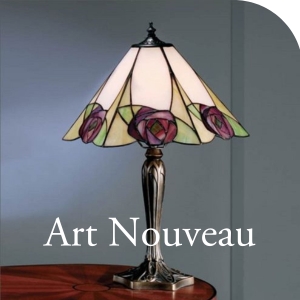
Art Nouveau lighting focused on quality and craftsmanship but, unlike the Arts and Crafts movement, mass production was tolerated which made items more accessible. Art Nouveau lights were fashionable towards the end of Queen Victoria’s reign. This was beautiful lighting that was graceful, symmetrical and fluid, with curvy lines and an emphasis on vertical height. Metals such as brass with an antique patina were used and metalwork designs would have included leaves, twisted plant tendrils, flowers, buds and seeds. Use of the female form, often depicted with flowing hair, was popular particularly in table lamps. Art Nouveau ceiling lights and wall lights would have featured lightly coloured or alabaster glass shades that were frequently etched in beautiful designs. Many Tiffany glass lamps, ceiling lights and wall lights were made in the Art Nouveau style and these are still popular today. Art Nouveau lighting works really well if you have vintage decorations and an Art Nouveau chandelier as a feature light in a dining room can look stunning.
The Edwardian era was brief, lasting only the 9 years of the reign of Edward VII from 1901 to 1911. It was nevertheless a breath of fresh air, a short period of peace, luxury and pleasure sandwiched between the rigid, industrial Victorian era and the outbreak of World War I. It became known as Belle Époque or the Beautiful Era. It was a fashionable society who enjoyed sport, leisure and travel. The wealthy would travel widely abroad and styles were influenced by continental Europe. Many modern conveniences made their mark during this period –refrigerators, vacuum cleaners, household detergents, cellophane, stainless steel, wireless and typewriters to name a few. Cars took to the roads of Britain for the first time with a top speed of 25mph. There was a rigid class system where everyone knew their place – think ‘Upstairs Downstairs’ – and a huge divide between the rich and poor. A rising interest in socialism was, however, bringing concern for the plight or the poor and the status of women.
Homes had a lighter, fresher, more informal and feminine feel, with bamboo and wicker furniture and light wooden block floors with oriental rugs - a move away from the heavy cluttered look of the Victorian era. Colours were lighter – pale pastel blue, lilac, green, yellow, and grey combined with pretty floral fabrics. Designers such as Charles Rennie Mackintosh, William Morris and Louis Comfort Tiffany were making their mark. Houses had fewer but larger rooms that Victorian houses, creating clean lighter spaces with simple detail.
Electric lighting was just being introduced and a few wealthier homes would have had electric light fittings in their drawing rooms or dining rooms. The majority of homes, however, still relied on a combination of gas lighting, candles and oil lamps as electric lighting did not become widespread until after World War 1. Lighting styles in the Edwardian era were beautiful and innovative and influenced by continental Europe, the Arts and Crafts and Art Nouveau movements. Edwardian light fittings were graceful using delicate metalwork to add elegance. Edwardian ceiling lights had simple linear designs with scrolling arms and pretty shades. Some of the more eye catching Edwardian chandeliers were multi-tiered and featured coloured and smoked glass. These Edwardian chandeliers look stunning in large hallways, hotel foyers and function rooms. Fabric shades in soft colours with decorative frills and tassels would have been used on Edwardian table lamps and standard lamps as well as on ceiling and wall lights. Gilded light fittings were popular and often used for ceiling lights and wall lights, and for lighting Edwardian bathrooms. Handmade Tiffany table lights were popular and these featured stained coloured glass in an array of beautiful colours and floral designs. Bronze metal table lamps featuring reclining female figures were popularly used for additional lighting.
17. Art Deco Lighting
ART DECO LIGHTING
The Art Deco period began in Europe in the early 20th century. The style became popular here in Britain after the First World War. Art Deco took its name from an exhibition held in Paris in 1925, although the style was already well established by that time.
To decorate in the Art Deco style keep rooms uncluttered and opt for pale beige, off-white or satin silver walls to maximise the light. Wall paper borders using zig-zag chevrons, stylised pictures of boats, planes, cars or skyscrapers, stepped profile mirrors, can all be used to add the definitive Art Deco detailing. Dark wooden tables and sideboards, black lacquered furniture and cocktail cabinets with subdued lighting are all very Deco. Use parquet or polished wooden floors or black and white checked linoleum and opt for shiny fabrics with bold geometric prints.
The Art Deco lifestyle died out in the mid to late 1930’s during the economic downturn and depression years. It was considered a brash obscene reminder of what never materialised. Having said that, Art Deco is currently undergoing a big revival at present and the Deco style can be seen in homes and hotels, not only in the UK, but around the world. It is easy to understand this re-emergence as the Art Deco style is supremely versatile and the perfect accompaniment to both modern and traditional décor.
The Art Deco years saw the birth of the modern lighting industry we know today with architectural lighting, lighting engineers and designers becoming big business. Electricity was now widely available and this allowed flexibility as light fittings could now be put where they were needed. Art Deco lighting has a timeless elegance and beauty that is perfect today for lighting in modern open plan homes and apartments and is of course is very much in keeping with period homes built during the 1920’s and 1930’s. Art Deco lights are streamlined and use strong geometric shapes and symmetrical lines often in bold colours or, for a more dramatic effect, black and white. Chrome was very much the new material of the time and when combined with glass readily lent itself to the production of light fittings with a sleek shiny look.
One of the most iconic lights from the Art Deco era is the Deco lady table lamp that features a female figure holding aloft a glass ball. Indirect lighting in coving that created a soft subdued light was also very popular and the fashion for reflecting lights off the ceiling led to the birth of the uplighter ceiling lights. Etched or sand blasted glass was used to fashion shades and parchment shades were frequently used on standard lamps. Tiffany lighting using coloured stained glass was very fashionable in the Art Deco era and today you can find a whole host of reproduction Tiffany lights in Art Deco styling. Neon lighting was used on the exterior of public buildings and many of our cinemas and hotels built during this era still have Art Deco style lighting.
18. Mid Century Lighting
MID-CENTURY LIGHTING
The inter-war years see housing styles change and in turn, the interior influences and styles of light fixtures. Throughout the middle part of the century (the 1930’s to the late 1960’s) the style of lighting went from brass traditional chandeliers through to an all together more modern style. New materials came to the fore which changed the architecture of British homes.
The Modernist Movement saw a shift in the design philosophy moving it towards simple functional designs which were more streamlined and understated. The forms were simple the movement rejected ornate decorative styles of the past instead drawing on an industrial look factory styled pendants were seem as functional and efficient.
The style whilst remaining simple took the forms of geometric shapes globes and triangle shaped lights in calm neutral colours. Material such as glass, metal and plastics were used prolifically.
The ceiling light largely took the shape of a single pendant light, adding more additional lighting with function was utilized. Spotlights with wall fixtures, angled desk lamps and floor lamps became important. Often called task lamps they mimicked work lamps used in factories.
Utilitarian in nature the minimal designs are arguably some of the iconic lighting styles of the midcentury. Some of the leading designers of the day heralded from Scandinavian countries and mid century lighting is now also described as Scandi or retro lighting.
Fluorescent and halogen were the light sources available at this time (whilst largely defunct and outmoded today) the shapes did give rise to new shaped light fixtures. It became a little experimental with linear shapes and multi headed lamps with cowls to direct light.19. Brutalism Style Lighting
BRUTALISM
Brutalism emerged in the mid-century; a style that used brutal materials in the raw such as concrete, brick and steel. The movement was criticised for being basic and harsh with no softer decorative elements. The light fixtures became larger very industrial designed to disrupt a room. In efforts to be functional and true to the rawness of brutalism, the light was stark fluorescent lighting. Factory style lamps hanging on chains with caged frontages, bullhead lamps and all forms of utility style lamps were chosen for the space.
Post-Modern movement ran along side this. Where lighting heralded back to a period before the modernity of brutalism. Post modern borrow elements of older style lighting such as art deco and reimagined it into a more sleek version.20. Late Mid Century Lighting
THE LATE MID-CENTURY LIGHTING
From the late 50’s, lighting takes inspiration from some of the technical advances and culture of the day. Scandinavian styles were still popular in the early part of the decade Styles such as iconic artichoke shapes rise and fall lamps and functional lights remained popular through the later part of the 20th century. Interestingly the icon lighting styles from Scandivain countries saw a revival again in the 21st century.
New variations came along in the late 50’s early 60’s at the time the space race dominated everything from fashion to children toys, we became obsessed with space travel and designs were new and exciting. Disc shaped lights like flying saucers were all the rage. Sputnik shapes where satellite shapes surrounded a circular centre point.21. Lighting for the Swinging 60's
THE SWINGING 60'S
Track lighting and large spotlights and big ceiling lamps shades were fashionable. Colours may have been a little brighter and bolder as were the fashions of the day.
The impact of the Big Screen bought American culture to the UK in three dimensional glamour. Bigger was better and this followed in our interiors too, with upright mid-century furniture being replaced by oversized squashy sofas and larger lights.22. Flower Power 70s Lighting
FLOWER POWER 70'S
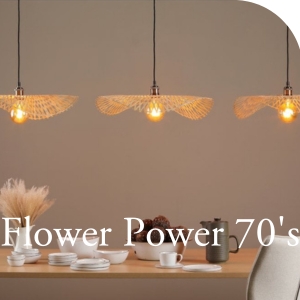
It was a whole new world of peace and love. The creative direction emerged was free spirited bohemian lifestyle. Favouring natural materials such as macrame plants hanging from ceilings. There was a liberal use of rattan, cork and jute. The lighting softened the mood of home lighting bring a vibe that was laid back and free. Mood lighting such as lamps were used liberally and lower levels of light were desired for creating mellow calming vibes.
Tinted glass lampshades smokey glass or brown glass pendant lights became popular, obscuring and diffusing the harshness of light bulbs.
Architectural style changed and housing became more like the modern architecture of today. Larger windows and flatter frontages. The homes of the day had open plan living, open staircases, everything had a feel of modernity. Some architectural homes had sloped angled rooflines and ceilings, giving rise to problems lighting the spaces. Spotlights began to be mounted on the ceilings using direct and indirect lighting effects to show off the space to the best effect. The angles made symmetry an issue and to counteract this, the angles would be offset with globe or dome shapes to juxtapose against the angles. Some homes had gallery landings and double height spaces which meant large feature lights cascading effects could be used.nd 90's Style Lighting
80'S AND 90'S STYLE LIGTHTING
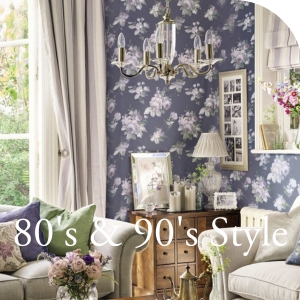
The 80's was the decade of chintz Laura Ashley a British designer was all the rage pretty patterned wall coverings and classical styled lighting. Art deco revival was also prolific in this era.
Towards the end of the decade the brass metal was deemed outdated and new chrome and stainless steel colours were favoured. Spotlight bars featuring swivel heads became super modern as we moved away from the traditional classic chandelier styles. Transitioning through to the 90’s, the tones became more muted with blond woods, whites and beiges teamed with less clutter and pattern.24. 21st Century Lights
THE 2020’S IS DEEMED TO BE CONTEMPORARY – THE CAROLEAN ERA
Sleek and modern, Contemporary or popular lights of the period vary considerably. In later years personal choice comes into play seeing more consumers buying bespoke or customised lighting that specifically suits their ideals. People are buying for longevity, made to last items. Along side this lighting with a strong focus on sustainability. This has seen an increase in lighting made by hand from plant based or natural easy to grow materials such as bamboo, wood and jute. Materials that can be recycled easily such as aluminium and glass are used prolifically in lighting.

.jpg)




.jpg)