‘Lights, Camera, Action’ was the traditional warning used to alert film crews at the beginning of a take and, although these actual words are not used anymore, we instantly think of the magic of the movies and the glitz and glamour associated with Hollywood. Hollywood started as a small community in the 1870’s and in the years that followed a hugely successful film industry developed there that would become famous the world over.
By today’s standards early film making was primitive – ‘moving pictures’ were created by taking a number of still frames in quick succession. This resulted in silent films with jerky movements but nonetheless audiences loved them and the Hollywood movie studios became big business. Gradually film makers began to place more emphasis on ‘telling a story’ and less on the simple ability to be able to produce a novelty.
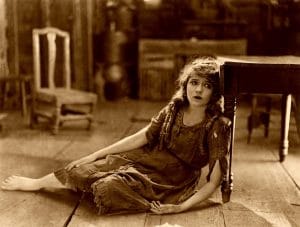
Mary Pickford, a popular and well loved actress, shown here in the 1922 silent movie ‘Tess of the Storm Country’
By the 1930’s a new era dawned with the development of sound and improved technology – Hollywood was entering its Golden Age. The role of the director became more important in the film making process and new genres such as musicals, westerns and horror were created. Movie stars began to achieve great fame, and sometimes notoriety in equal measure. With the advent of colour film in the 1940’s and further advances in special effects and sound quality, films were becoming modern and more polished.
Film making is all about creating an illusion and lighting is very much part of generating this illusion. Part of a cinematographer’s job is to visually enhance and support the story using light – it is critical to focusing the audience’s attention and influencing their emotions.
Clever use of lighting can bring a scene or character to life, create mood, dimension and texture and hide or reveal aspects of the frame. Deep shadows for instance can make a character seem sinister, untrustworthy or downright evil. Ever experienced the hairs on the back of your neck standing up whilst watching a horror movie? The way the scene is lit goes a long way to creating this effect. Bright, diffused lighting, on the other hand, can provide comfort, create cheerfulness and harmony.
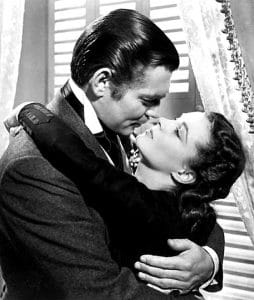
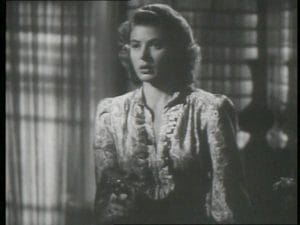
Vivien Leigh and Clarke Gable in 1939 epic ‘Gone with the Wind’ (on the left) and Ingrid Bergman in the classic 1942 film ‘Casablanca’ (on the right). These two shots illustrate how lighting can be used to influence mood.
Film lighting can either be hard or soft and the standard lighting method used in the film and theatre industry is known as ‘Three Point Lighting’. Hard lighting has sharp distinct shadows whilst soft lighting is less well defined with softer shadows and less background. ‘Three Point Lighting’ simply refers to the position of the lights in relation to the subject and the three lights are ‘key light’, ‘fill light’ and ‘back light’. ‘Key light’ shines directly on the subject and is the main bright source of illumination. In outdoor daytime shots, the sun often serves as the key light. ‘Fill light’ also shines on the subject but is a softer lower level light often aimed from the side, which fills in any unwanted shadows created by the key light. ‘Back light’, as the name would suggest, lights the subject from behind, often from one side or the other, and creates an illusion of depth. By changing the angles of these three lights in relation to each other and utilising hard and soft lighting, cinematographers can achieve a whole host of different lighting effects.
By comparison, lighting in our own homes should be so easy as, generally, our focus of attention is not moving! Yet many people struggle to get it right. There is not really a simple answer as the lighting you choose for a particular room is much dependent on personal taste and will be influenced by the age of your home and the furnishings and decorations you already have. But there are a few simple ‘rules’ or guidelines that may help.
 This well lit kitchen uses a combination of ceiling down lights, under cabinet lighting and three bold Arabesque pendants over the kitchen island. These globe pendants, from our Manhattan American Collection, are finished in a silver leaf patina and laser cut to produce the unique lighting effect.
It is often the case that we do not consider the lighting in a room until after we have finished the renovations or decorating and if there is one piece of advice we can give it would be to have a think about the lighting at the planning stage and not as an afterthought. That way if you want to have extra lighting you can ensure the necessary wiring and sockets are installed before it’s too late.
As with the movie industry, we too have three main types of lighting that work together for home lighting – ambient lighting, task lighting and accent lighting. Ambient lighting works in much the same way as key lighting does in the movies – it provides an area with overall illumination. It should provide you with a comfortable level of brightness, without glare, that allows you to see and walk around safely. It is usually achieved by having a central ceiling light or chandelier and may include wall light fittings too. Having good ambient lighting is key to a good lighting plan.

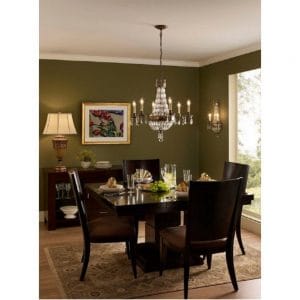
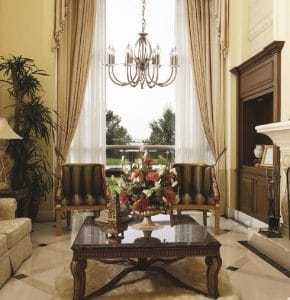
The rooms shown above all have central chandeliers that give good ambient light. The sitting room on the left benefits from natural daylight on three aspects and after dark the large 8 light Carisbrooke chandelier with its distinctive sweeping arms will come into play by providing the background lighting. The charming dining room in the centre features our Bellini 6 light chandelier which is lavishly dressed with antique quartz crystal. It is positioned centrally over the table to give ambient light and further background light is provided by the matching wall light. The sitting room in the image on the right shows the Aegean 8 light polished brass chandelier from our Chester Lighting Collection – this ambient light is perfectly framed in the centre of the window.
Task lighting does what it says on the tin and provides light for specific tasks such as reading, grooming, cooking food, doing homework, craft work or checking the finances. It can be provided by recessed lighting under cabinets, pendant lights over tables as well as desk lights and floor reading lamps.
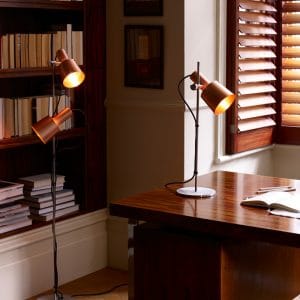

Two perfect examples of task lighting. The desk lamp and double headed floor lamp on the right, with their distinctive 1960’s retro styling, are from British lighting company Original BTC. With striking satin copper shades that can be angled and adjusted to put the light onto the task in hand they are both practical and stylish. Our picture on the right shows a delightful way to light a pool table. This magnificent Tiffany Inglenook pendant is made from 496 individual pieces of stained glass painstakingly handcrafted with copper foil in the American Arts and Crafts style. It would make a super kitchen island pendant too.

We just had to include these aptly named Cabaret wall lights as they will inject some Hollywood glamour to any bathroom or dressing room. The perfect theatrical look when used to frame a mirror and great as task lights for shaving or applying make-up. With an IP44 rating they are safe for use in a bathroom.
Accent lighting, rather like back lighting in the movies, is used to create visual interest by drawing your eye towards specific items in the room. Maybe it’s a picture light over a painting or illumination focused on other features in the room, or it could be highlighting a feature wall to bring out the texture of the brick or stone. Table lamps and floor lamps also provide great accent lighting for dark corners.
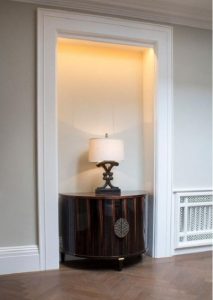
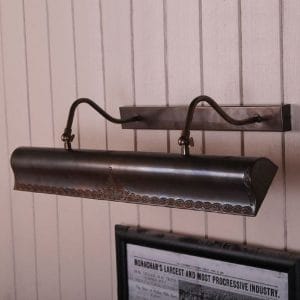
The unusual table shown above sits nicely in the alcove to provide a striking focal point, whilst accent lighting is provided by our Westwood table lamp. The traditional Spence picture light, shown on the right, is used to highlight the framed poster below. It is manufactured in cast brass with an antique finish.
The last important question to consider when planning the lighting for your room is – ‘how much light do I actually need in my room?’ There are some simple calculations that will help you work this out and we have covered this topic in one of our previous blogs – simply click on the link below to read more.
https://www.bespokelights.co.uk/blog/2015/03/how-much-light-is-needed-in-a-room/
Finally, we are always happy to answer any lighting related questions you may have. Simply contact us here at Bespoke Lights using this link
https://www.bespokelights.co.uk/contact-us-i3