
One of our most frequently asked questions is ‘Can I use this light in my bathroom?’ Bathrooms are by definition ‘wet rooms’ and we all know that water and electricity don’t mix, so to ensure our safety there are specific rules and regulations that apply to bathroom lighting. They are applicable not only in commercial situations but also in our own bathrooms at home too. These regulations are rightly rigorous, stating that bathroom light fittings must be completely encased to avoid shorting and electric shock. For your own protection please don’t be tempted to use a conventional light fitting that is not specifically designed for bathroom use.

Light fittings are given a two digit number known as an IP number. IP stands for ‘Ingress Protection’ and is always followed by two digits. The first number of the IP rating indicates the degree of protection against dust particles or solid objects and ranges from 0 for no protection up to 6 for total protection. It is the second number that is of more interest in bathroom lighting as this represents the degree of protection from water and steam and ranges from 0 for no protection up to 8 for a light that will be totally submerged in water. It is important that you select fittings with the correct rating according to where they are to be sited within the bathroom.
1 – protected against solid objects greater than 50mm (e.g. accidental touch by hands);
2 – protected against solid objects up to 12mm (e.g. fingers);
4 – protected against solid objects greater than 1mm (e.g. small tools and wires);
5 – protected against dust, limited ingress (e.g. no harmful deposit);
6 – totally protected against dust.
1 – protection against vertically falling drops of water (e.g. condensation)
2 – protection against direct sprays of water up to 15 degrees from vertical
3 – protection against direct sprays of water up to 60 degrees from vertical
4 – protection against water sprayed from all directions – limited ingress permitted
5 – protected against low pressure jets of water from all directions – limited ingress permitted
8 – watertight against long periods of immersion under pressure

Zone 0 – this is inside the bath or shower itself and any light here must be low voltage (max. 12 volts) and rated at least IP67 which will provide total protection when immersed in water.
Zone 1 – is above the bath or shower to a height of 2.25 metres above floor level and a light fitting with a minimum of IP44 is needed here.
Zone 2 – an area stretching to 0.6 metres outside the perimeter of the bath and above the bath or shower if over 2.25 metres. A light fitting of at least IP44 is needed. Zone 2 also includes the area above the sink in a radius of 0.6 metres from the taps.
Not Zoned – refers to the area beyond Zone 2 and was previously known as Zone 3. There is no longer a specific IP number for this area and any light fitting can be used unless it is specifically marked as not for use in bathrooms.

Light switches for bathrooms must be either outside the room or fitted with a pull cord. The lighting circuit within a bathroom should be protected with a 30ma residual current device (RCD) commonly known as a circuit breaker – this is a sensitive safety device that switches off the electricity automatically if there is a fault and protects against electrocution. All new installations and modifications to the electrical wiring within bathrooms and shower rooms should be carried out by a qualified electrician who should issue a certificate for the work carried out.
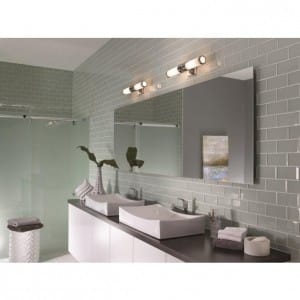
Choosing the best lighting for the busiest room in your house is important. Bathrooms need good flexible lighting – bright clear lights are essential as you prepare for the day ahead by shaving or applying make-up but later when you
 want to relax by taking a long soak in your bath you will want to have more atmospheric lighting. Fortunately Bespoke Lights have a great selection of suitable and safe bathroom rated lights for both traditional and modern bathrooms. So whether you want to turn the lights up or dim them down we have plenty of solutions.
